Double Benders: How Rebar Plants Double Their Bending Output
Long bars with bends at both ends are everyday business in any rebar plant: beam reinforcement, wall connections, special shapes. On a single head machine this means double handling, because the bar has to be turned around and repositioned. This is exactly the problem the double bender solves.
The principle
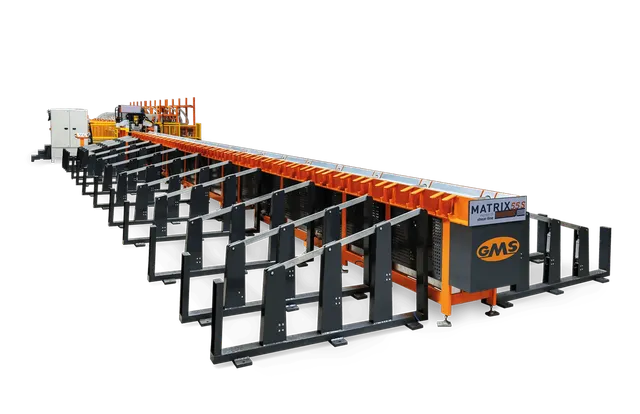
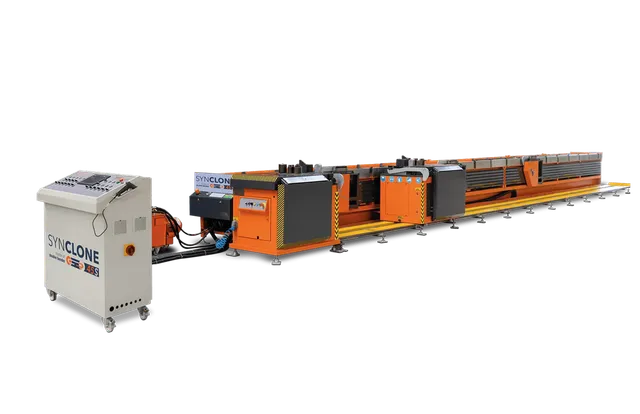
A double bender like the GMS SYNCLONE 45S has two bending heads, at least one of which travels along the machine bed. Both ends of a bar are bent in a single operation, even at lengths of 12 metres and more. Flipping long bars is eliminated entirely.
The productivity effect
The time saved goes beyond bending two ends at once. With long, heavy bars, handling is the real time killer: lifting, turning, repositioning, aligning. A double bender removes that entire step. In practice, output per operator rises significantly while physical strain drops. A point that matters more every year when recruiting staff.
Precision on series parts
Both bending heads run on the same program control. Angles, positions and sequence are stored, so every part in the series is identical. Especially for components with tight tolerances, for example in precast plants, this repeat accuracy is worth real money.
Who should invest in a double bender?
In short: any operation where long bars with bends on both ends occur regularly. Precast plants, large rebar fabricators and infrastructure suppliers are the typical users.
Conclusion
The double bender is not a niche machine but the standard in modern rebar plants across Europe. Find the details on the GMS SYNCLONE 45S on the product page, or reach us through the contact form for tailored advice.
FAQ
What bar lengths can a double bender process? Thanks to the travelling bending head, standard lengths of 12 metres and beyond are no problem. The machine adapts to the bar length, not the other way round.
Does a double bender replace a conventional bending machine? It complements it. Short parts and single bends often remain more economical on a conventional machine. Combining both types covers the full spectrum.
How many operators does the line need? One operator is sufficient in normal operation. For very heavy bars, a second worker assists with handling.